

Are you safe to drive?
As individuals, with the ongoing march of technological development, we are progressively moving toward an era where we are immersed in augmented reality (AR) or virtual reality (VR) and these are becoming a regular part of how we live, interact and communicate.
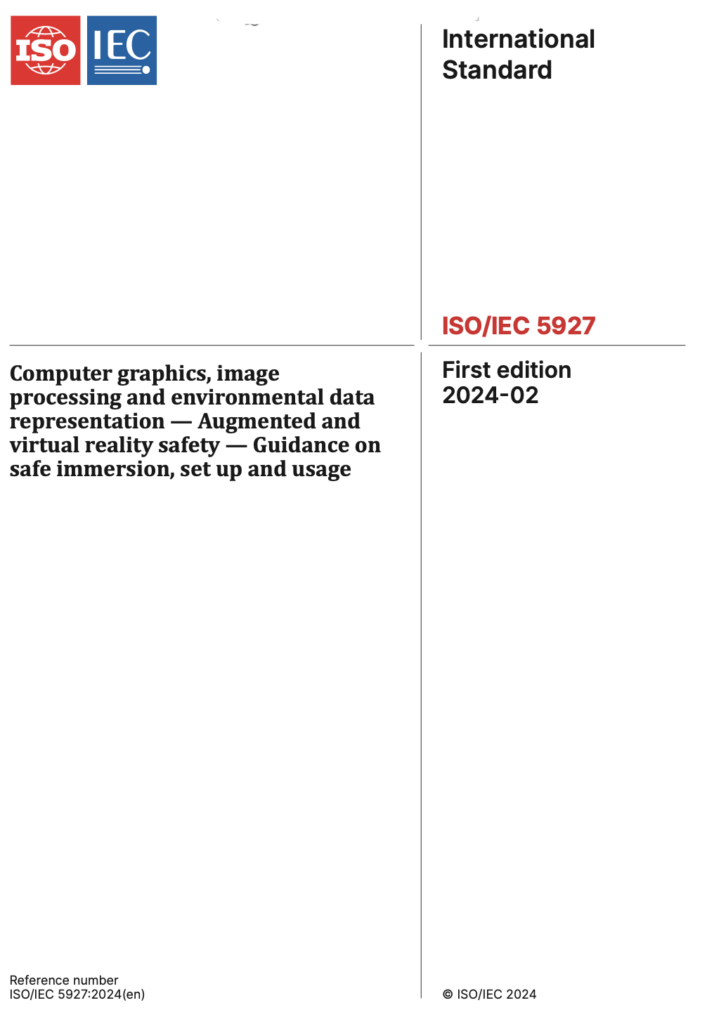
ISO/IEC JTC 1/SC 24 has recently published a new standard ISO/IEC 5927:2024 Computer graphics, image processing and environmental data representation — Augmented and virtual reality safety — Guidance on safe immersion, set up and usage. This standard describes both safe practices for the setup of AR and VR systems and goes as far as highlighting health and safety implications, risks and ethical issues when related to immersion time, privacy, inclusion, online bullying and societal impact.
This standard is the culmination of several years of market research and consultation both with industry stakeholders and consumers. It offers direction on to how to address some of the health and safety issues experienced and possible affects like motion sickness, blurred vision and temporary disorientation.
Setup and usage of AR/VR devices play an important part of the overall health and safety aspects. Setup should be done using manufacturer’s recommendations, including positioning of devices for viewing, brightness of display and the securing of attachments which might be pertinent to the real world, not just the virtual world. Before using AR/VR devices, users need to ensure that their real-world environment is large enough and doesn’t have any obstacles that might pose a health and safety risk. Further, other people or animals might also be transiting through the real-world space, which overlaps with the virtual world, and can pose risks of unexpected collisions etc.
After the use of an AR/VR system for some time there are several related symptoms that we need to be conscious of including decreased reaction time, fatigue, nausea and insomnia. The effects of many of these issues can be reduced through optimum setup and careful consideration of use and length of use. However, prolonged use even with a manufacturer’s setup has been shown to:
“cause short term and long term issues that can affect a person’s ability to operate heavy machinery and drive vehicles”[1]
Mining in the Metaverse
As a real-world example, in Australia there is a project underway looking at how a user in the real world could connect [2], with the use of AR and VR, to a domain in the Metaverse that has a persistent digital/electronic connection to a physical mine. Notwithstanding the complexity of the technology needed to establish this environment in the first place including sensors, communications, cloud-based architecture and appropriate software, the Metaverse is still in its infancy and has a long journey ahead before technology standards are prominent enough to make the Metaverse a single virtual world, as opposed to multiple, specifically defined, virtual environments customized for applications like gaming.
From a safety and risk point of view, having a user operating in a mine virtually, means that the user is safe from harm from mine-related hazards and risks, such as seismic activity, gas and fire. This therefore carries a significant amount of benefit to personal health, by reducing risk and also reduces risk and liability to the organization. However, since mining is a continuous process, a user is likely to remain connected, virtually, for an extended duration, hence the need for different visualization systems for different activities.
This is where ISO/IEC 5927:2024 could help to reduce both short and long term effects, similar to the world of diving, where hyperbaric chambers are used for periods after a diver has surfaced. This standard can help to reduce the impact and bring a user back to interact safely with the real world.
Further reading:
[2] Towards a Mining Metaverse – Stothard P, Ryan P, Kurata T, Stapleton D. Towards a mining metaverse. Mining Technology. 2024;0(0). doi:10.1177/25726668241242232
ISO/IEC 5927:2024 Computer graphics, image processing and environmental data representation — Augmented and virtual reality safety — Guidance on safe immersion, set up and usage.
https://committee.iso.org/standard/81847.html?browse=tc
This Article: Doug Stapleton
JTC 1/SC 24/WG 11 Health, safety, security and usability of Augmented and Virtual Reality (AR/VR)
[1] Department of business. Energy & Industrial Strategy (UK), The safety of domestic virtual reality systems, A literature review 2020 Available from: https://assets.publishing.service.gov.uk/government/uploads/system/uploads/attachment_data/file/923616/safety-domestic-vr-systems.pdf