

Database languages are a vital component of the information management industry and have had a profound impact on the industry.
ISO/IEC JTC 1/SC 32/WG 3 (“WG3 Database Languages” or “WG3”) is the international committee responsible for developing database language standards. WG3 is at the forefront of developing and enhancing languages that support industries’ data analysis, retrieval, and manipulation requirements.
The two most well-known and impactful standards produced by WG3 are ISO/IEC 9075 Database Language SQL and ISO/IEC 39075 Database Language GQL.
Members
WG3 comprises individual experts from national body standards groups. In 2025, the active individual experts come from:
- China
- Germany
- Japan
- Korea
- Netherlands
- Sweden
- United Kingdom
- USA
- Liaison participants from LDBC (Linked Data Benchmark Council)
Individual experts are WG3 participants who represent their own opinions as experts in the technology, rather than national body positions.
Standard stages
The standards process has several defined stages with processes for advancing from one stage to another:
- New Work Item Proposal (NWIP) – describing the scope of a project.
- Working Draft (WD) – internal to the working group, multiple iterations
- Committee Draft (CD) – Consultation and comments at the SC level
- Draft International Standard (DIS) – Ballot and comments at the JTC1 level
- Final Draft International Standard (FDIS) – needed if the DIS ballot results in technical changes
- International Standard (IS) – published standard
The CD, DIS, and FDIS stages produce comments (feedback) from parties outside of WG3. WG3 participants must resolve the comments produced at one stage before the draft standard can progress to the next stage.
Once a standard is published, WG3 starts on the next revision.
Projects
WG3 has three projects that have been published and are in ongoing development. There is also one recently started project which is in the Working Draft phase.
9075 Database Languages – SQL
(First published 1987) The SQL language standard is for databases that model data as though it is stored in tables.
39075 Database Languages – GQL
(Initiated in 2019, first published 2024) The GQL language standard is for databases that model data as though it is stored in a graph structure (nodes and connected edges).
19075 Guidance Standards
(First published 2011). The 19075 guidance standards are a supplement to the 9075 SQL standards. Whereas 9075 provides the complete formal specification of syntax, functionality, and behavior, 19075 documents provide a more approachable presentation and additional perspective on selected features. The current set of guidance standards is:
- 19075-1:2021 Information technology — Guidance for the use of database language SQL — Part 1: XQuery regular expressions
- 19075-2:2021 Information technology — Guidance for the use of database language SQL — Part 2: Time-related information
- 19075-3:2021 information technology — Guidance for the use of database language SQL — Part 3: SQL embedded in programs using the JavaTM programming language
- 19075-4:2021 Information technology — Guidance for the use of database language SQL — Part 4: Routines and types using the Java™ programming language
- 19075-5:2021 Information technology — Guidance for the use of database language SQL — Part 5: Row pattern recognition
- 19075-6:2021 Information technology — Guidance for the use of database language SQL — Part 6: Support for JSON
- 19075-7:2021 Information technology — Guidance for the use of database language SQL — Part 7: Polymorphic table functions
- 19075-8:2021 Information technology — Guidance for the use of database language SQL — Part 8: Multidimensional arrays
- 19075-9:2022 Information technology — Guidance for the use of database language SQL — Part 9: Online analytic processing (OLAP) capabilities (Guide/OLAP)
- 19075-10:2024 Information technology — Guidance for the use of database language SQL — Part 10: SQL model (Guide/Model)
29075 Function Libraries
(Begun 2024). The function library specifications are intended to document interfaces for a variety of analytical functions. Two documents are currently under development:
- 29075-1 Information technology — Function libraries for advanced analytics in data management — Part 1: Framework
- 29075-2 Information technology — Function libraries for advanced analytics in data management — Part 2: Statistical functions
Process
WG3 Database Languages is driven by written documents that propose changes to a draft standard. These documents are reviewed and discussed in WG3 meetings. The change proposals generally include a discussion section that describes and explains the proposed change and a proposal section that specifies the exact changes needed to implement the proposal in the current draft standard. The length of a change proposal varies from a couple of pages to over a hundred pages, depending on the complexity of the discussion section and the actual changes.
If the WG3 participants accept the change proposal, the WG3 editors will incorporate the changes into the next version of the draft standard. WG3 has archives of over thirty years of change proposals.
WG3 Database Languages holds week-long in-person meetings (with remote access) two to three times a year and additional web conferences as required.
Get Involved
Individual experts can join WG3 by joining their national standards body. National body committees that correspond to SC32 WG3 are often (but not always) referred to as “mirror committees”.
The requirements and costs for joining depend on the national standards body. More information can be found at:
- Canada – SCC
- China – SAC
- Germany – DIN
- Italy – UNI
- Japan – JISC
- Korea – KATS
- Netherlands – NEN
- Singapore – SSC
- USA – INCITS[1]
- UK – BSI
For other national bodies, see the ISO/IEC JTC 1 Participation page.
JTC 1 structure
The designation “ISO/IEC JTC 1/SC 32/WG 3” incorporates a hierarchical structure:
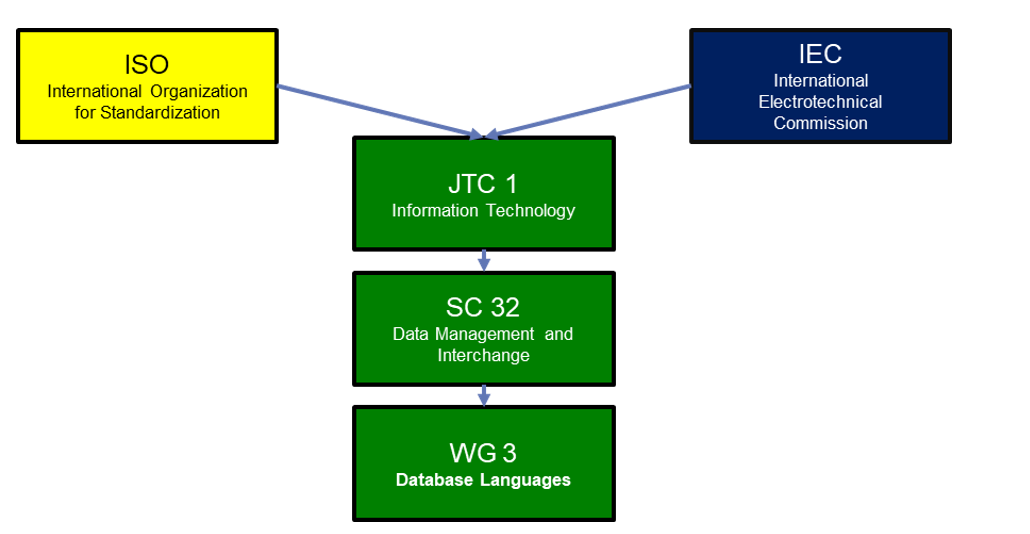
- ISO – International Organization for Standardization
- IEC – International Electrotechnical Commission
- JTC 1 – Joint Technical Committee 1 – Information Technology standards
- SC 32 – Sub Committee 32 – Data Management and Interchange
- WG 3 – Working Group 3 – Database Languages
____________________
[1] Technically, the USA standards organization is ANSI, but within the ANSI structure, the INCITS Data Management committee is the USA committee that corresponds to SC32 and WG3. Other national bodies may have similar complications.