

ISO/IEC JTC 1/SC35
User interfaces
September 2025
ISO/IEC JTC 1/SC 35 was created at the 1999-01 Rio de Janeiro – Brazil JTC 1 Plenary out of JTC 1/SC 18/WG9. All their projects were transferred to ISO/IEC JTC 1/SC 35. It has 19 participating members and 18 observing members.
Scope:
Standardization in the field of user-system interfaces in information and communication technology (ICT) environments and support for these interfaces to serve all users, including people having accessibility or other specific needs, with a priority of meeting the JTC 1 requirements for cultural and linguistic adaptability.
This includes :
- user interface accessibility (requirements, needs, methods, techniques and enablers);
- cultural and linguistic adaptability and accessibility (such as evaluation of cultural and linguistic adaptability of ICT products, harmonized human language equivalents, localization parameters, voice messaging menus);
- user interface objects, actions and attributes;
- methods and technologies for controlling and navigating within systems, devices and applications in visual, auditory, tactile and other sensorial modalities (such as by voice, vision, movement, gestures);
- symbols, functionality and interactions of user interfaces (such as graphical, tactile and auditory icons, graphical symbols and other user interface elements);
- visual, auditory, tactile and other sensorial input and output devices and methods in ICT environments (for devices such as keyboards, displays, mice);
- user interfaces for mobile devices, hand‐held devices and remote interactions.
SC 35 Meetings
The SC35 Working Groups meet two times per year:
Past meetings
- Quebec, Canada, 1999-06
- Paris, France, 1999-11
- Nara, Japan, 2000-05
- Quebec, Canada, 2000-11
- Stockholm, Sweden, 2001-05-31
- Paris, France, 2001-12-01
- Copenhagen, Denmark, 2002-06-03
- Athens, Greece, 2002-11-18
- Sendai, Japan, 2003-05-26
- Paris, France, 2003-12-01/05
- Tokyo, Japan, 2004-05-31/06-04
- Stokholm, Sweden, 2004-11-22/26 (Working Groups)
- Madison, USA, 2005-07-05/09 (Working groups and Plenary)
- Berlin, Germany, 2006-02-13-17 (Working Groups)
- Jeju, Korea, 2006-09-04/08 (Working Groups and Plenary)
- Paris, France, 2007-02-19/23 (Working Groups)
- Quebec, Canada, 2007-08-20/24 (Working Groups and Plenary)
- Fukuoka, Japan, 2008-02-08/12 (Working groups)
- Naples, Italy, 2008-09-08/12 (Working Groups and Plenary)
- Berlin, Germany, 2009-02-16/20 (Working Groups)
- Saskatoon, Canada, 2009-08-22/26 (Working groups and Plenary)
- Madrid, Spain, 2010-02-22/26 (Working Groups)
- Venice, Italy, 2010-08-23/27 (Working groups and Plenary)
- Bellevue WA, USA, 2011-02-21/25 (Working Groups)
- Warsaw, Poland, 2011-08-29/09-02 (Working Groups and Plenary)
- Kyoto, Japan, 2012-02-20/24 (Working Groups)
- Paris, France, 2012-08-27/31 (Working Groups and Plenary)
- Busan, Korea, 2013-03-18/22 (Working Groups)
- Saskatoon, Canada, 2013-08-26/30 (Working Groups and Plenary)
- Barcelona, Spain, 2014-02-10/13 (Working Groups)
- Hanghzou, China, 2014-07-07/11 (Working Groups and Plenary)
- Copenhagen, Denmark, 2015-01-19/23 (Working groups)
- Sapporo, Japan, 2015-08-31/09-04 (Working groups and Plenary)
- Rome, Italy, 2016-02-15/19 (Working groups)
- Seoul, Korea, 2016-08-01/05 (Working groups and Plenary)
- Berlin, Germany, 2017-02-06/10 (Working groups)
- Paris, France, 2017-07-24/28 (Working groups and Plenary)
- Geneva, Switzerland, 2018-02-12/16 (Working groups)
- Okayama, Japan, 2018-08-27/31 (Working groups and Plenary)
- Dublin, Ireland, 2019-02-18/21 (Working groups and Plenary)
- Shanghai, China, 2019-07-29 (Working groups and Plenary)
- Busan, South Korea, 2020-01-17 (Working groups and Plenary)
- Virtual meeting, 2021-01-18 (Working groups and Plenary)
- Virtual meeting, 2021-07-26 (Working groups and Plenary)
- Virtual meeting, 2022-01-17 (Working groups and Plenary)
- Virtual meeting, 2022-07-04 (Working groups and Plenary)
- Berlin, Germany, 2023-02-06 (Working groups and Plenary)
- Matsue, Japan, 2023-07-11 (Working groups and Plenary)
- Paris, France, 2024-01-29 (Working groups and Plenary)
- Saskatoon, Canada, 2024-08-26 (Working groups and Plenary)
- Seoul, Republic of Korea, 2025-01-13 (Working groups and Plenary)
- Virtual meeting, 2025-07-21 (Working groups and Plenary)
Organization within SC 35
JTC 1/SC 35 is subdivided in 7 permanent Working Groups
- WG 1 : Keyboards and Input Interfaces – Dr. Jeong HUYK (Korea, Republic of)
WG 1 specializes in keyboard layouts, input methods, and virtual interfaces, playing a pivotal role in standardizing how users interact with digital systems through text and command input. Its scope encompasses the design, functionality, and usability of physical and virtual keyboards, ensuring consistency, efficiency, and accessibility across devices and languages.
WG 1’s work includes developing comprehensive standards for keyboard layouts, covering everything from alphanumeric and numeric sections to editing, function, and multilingual input. These standards address both traditional keyboards and emerging technologies, such as virtual keyboards and on-screen keyboards with direct touch interfaces, which are increasingly important in mobile and touch-based devices.
Through its standards, WG 1 facilitates seamless, efficient, and inclusive text input, making digital interaction more accessible and effective for users worldwide. Their work is foundational for both legacy systems and cutting-edge technologies, ensuring that keyboards and input methods continue to evolve in step with user expectations and technological progress.
- WG 2 : Graphical User Interface and Interaction – Dr. Yoshikazu YAMAMOTO (Japan)
WG 2 scope encompasses the standardization of icons, symbols, avatars, virtual humans, and accessibility interfaces—key elements that facilitate intuitive and inclusive interaction between users and digital systems. is. The group also addresses accessibility, ensuring interoperability with assistive technologies for users with diverse needs, as seen in standards for Linux/UNIX and Java accessibility APIs. By developing guidelines for user interface objects, actions, and attributes, WG 2 plays a pivotal role in harmonizing visual and interactive elements across platforms, fostering consistency, usability, and innovation in human-computer interaction.
- WG 4 : User Interfaces for Mobile Devices – Dr. Yoshikazu YAMAMOTO (Japan)
WG 4 focuses on user interface design principles and interaction techniques, with a particular emphasis on navigation, input methods, and usability across diverse devices and contexts. Its scope covers standards that ensure intuitive, efficient, and accessible user experiences, especially in mobile, menu-driven, and pen-based environments.
Additionally, WG 4 explores progressive interfaces and universal design principles, aiming to create adaptable and inclusive user interfaces that cater to users with varying abilities and contexts.
- WG 5 : Cultural and Linguistic Adaptability – Mr. Thibault GROUAS (France)
The WG 5 specializes in user interfaces that bridge cultural, linguistic, and accessibility barriers, with a strong focus on multimodal interaction, speech technologies, and adaptability for diverse user needs. Its scope is centred on enabling seamless communication and interaction across languages, cultures, and abilities, making digital interfaces more inclusive and effective in global contexts.
WG 5’s work encompasses standards for speech translation systems, including end-to-end speech-to-text translation and automatic simultaneous interpretation, which are critical for real-time, multilingual communication in both customer service and face-to-face scenarios. The group also addresses full-duplex speech interaction, ensuring natural and fluid conversational experiences between users and systems. By standardizing multimodal interaction—such as combining speech, text, and gestures—WG 5 plays a pivotal role in advancing user interfaces that are not only technologically advanced but also culturally sensitive, linguistically inclusive, and universally accessible.
- WG 6 : User Interface Accessibility – Dr. David Fourney (Canada)
WG 6’s work addresses a wide range of accessibility needs, from visual and auditory presentations of information—such as captions, subtitles, audio descriptions, and sign language—to hardware and software accessibility for personal computers, kiosks, and other interactive systems. The group provides comprehensive frameworks for mapping user accessibility needs, ensuring that products and services are designed with inclusivity in mind from the outset.
The group also focuses on augmentative and alternative communication (AAC), supporting individuals who rely on symbols, pictograms, or assistive technologies to interact with digital interfaces.
By fostering interoperability with assistive technologies (AT), WG 6 ensures that accessibility features are seamlessly integrated into mainstream ICT products.
- WG 9: Natural user interfaces and interactions – Jee-in KIM (Korea, republic of)
WG 9 focuses on innovative and natural user interfaces, particularly those that leverage gestures, voice, and whole-body movements to create more intuitive and immersive interactions between users and digital systems. Its scope is centered on standardizing the design, implementation, and evaluation of gesture-based, voice-driven, and natural user interfaces (NUIs), ensuring consistency, usability, and accessibility across diverse devices and platforms.
WG 9’s work includes developing guidelines for gesture-based interfaces, such as multi-point and single-point gestures, which are essential for touchscreens, screen readers, and other interactive systems.
By evaluating the usability of natural user interfaces and providing frameworks for their design, WG 9 plays a crucial role in shaping the future of human-computer interaction, making technology more adaptive, inclusive, and aligned with human behavior and expectations.
- WG 10: Affective computing – Hongan Wang (China)
WG 10 is at the forefront of standardizing affective computing user interfaces (AUI), a field that integrates emotion recognition, representation, and interaction into digital systems. Its scope revolves around creating frameworks and guidelines for interfaces that can perceive, interpret, and respond to human emotions, thereby enabling more empathetic, adaptive, and human-centered technology.
WG 10’s work includes developing models and methodologies for affective computing, such as the emotion annotation and emotion representation standards, which are essential for accurately capturing and conveying emotional states in digital environments.
Additionally, WG 10 is pioneering standards for affective interaction design, particularly in specialized contexts like in-cabin services, where emotional responsiveness can enhance user experience and safety.
By standardizing how emotions are integrated into user interfaces, WG 10 is shaping the future of human-computer interaction, making technology more intuitive, responsive, and attuned to the emotional needs of users.
Programme of work:
As of September 2025, ISO/IEC JTC 1/SC 35 has published a total of 92 documents and 23 projects are under development:
|
ISO/IEC FDIS 4933 : Information technology — User interfaces — Unifying input actions across devices |
WG 9 |
|
ISO/IEC PRF 7818 : Information technology — User interfaces — Framework of voice user interfaces for personal mobility services |
WG 9 |
|
ISO/IEC FDIS 9995-1 : Information technology — Keyboard layouts for text and office systems — Part 1: General principles governing keyboard layouts |
WG 1 |
|
ISO/IEC FDIS 9995-2 : Information technology — Keyboard layouts for text and office systems — Part 2: Alphanumeric section |
WG 1 |
|
ISO/IEC FDIS 9995-3 : Information technology — Keyboard layouts for text and office systems — Part 3: Latin International keyboard layout |
WG 1 |
|
ISO/IEC PRF 9995-4 : Information technology — Keyboard layouts for text and office systems — Part 4: Numeric section |
WG 1 |
|
ISO/IEC DIS 9995-7 : Information technology — Keyboard layouts for text and office systems — Part 7: Graphical symbols used to represent functions |
WG 1 |
|
ISO/IEC FDIS 9995-9 : Information technology — Keyboard layouts for text and office systems — Part 9: Groups and mechanisms for multilingual and multiscript input |
WG 1 |
|
ISO/IEC PRF 9995-10 : Information technology — Keyboard layouts for text and office systems — Part 10: Conventional symbols and methods to represent graphic characters not uniquely recognizable by their glyph on keyboards and in documentation |
WG 1 |
|
ISO/IEC FDIS 9995-11 : Information technology — Keyboard layouts for office systems — Part 11: Functionality and labelling of dead keys |
WG 1 |
|
ISO/IEC CD 20071-24 : Information technology — User interface component accessibility — Part 24: Visual presentation of audio information in sign languages |
WG 6 |
|
ISO/IEC DIS 20071-31 : Information technology — User interface component accessibility — Part 31: Accessibility of kiosks |
WG 6 |
|
ISO/IEC CD TS 20071-40 : Information technology — User interface component accessibility — Part 40: Augmentative and alternative communication (AAC) |
WG 6 |
|
ISO/IEC CD TS 20071-41 : Information technology — User interface component accessibility — Part 41: Design and use of pictograms, photos, and icons in augmentative and alternative communication (AAC) |
WG 6 |
|
ISO/IEC DIS 22121-1 : Information technology — Virtual keyboards user interfaces — Part 1: General guidelines and requirements |
WG 1 |
|
ISO/IEC FDIS 22121-3 : Information technology — Virtual keyboards user interfaces — Part 3: Virtual keyboards interactions |
WG 1 |
|
ISO/IEC DIS 24216-1 : Information technology — User interface guidelines on avatars — Part 1: General |
WG 2 |
|
ISO/IEC AWI 25420 : Information technology — User interfaces — Multimodal interaction for customer service systems |
WG 5 |
|
ISO/IEC CD 25421 : Information technology — User interfaces — Describing whole-body movement sequences |
WG 9 |
|
ISO/IEC DIS 29138-4 : Information Technology — User interface accessibility — Part 4: Applying user accessibility needs |
WG 6 |
|
ISO/IEC DIS 30113-62 : Information technology — Gesture-based interfaces across devices and methods — Part 62: Multi-point gestures for screen readers |
WG 9 |
|
ISO/IEC CD 30150-11 : Information technology — Affective computing user interface (AUI) — Part 11: Emotion representation |
WG 10 |
|
ISO/IEC CD 30150-31 : Information technology — Affective computing user interface (AUI) — Part 31: Emotion annotation
|
WG 10 |

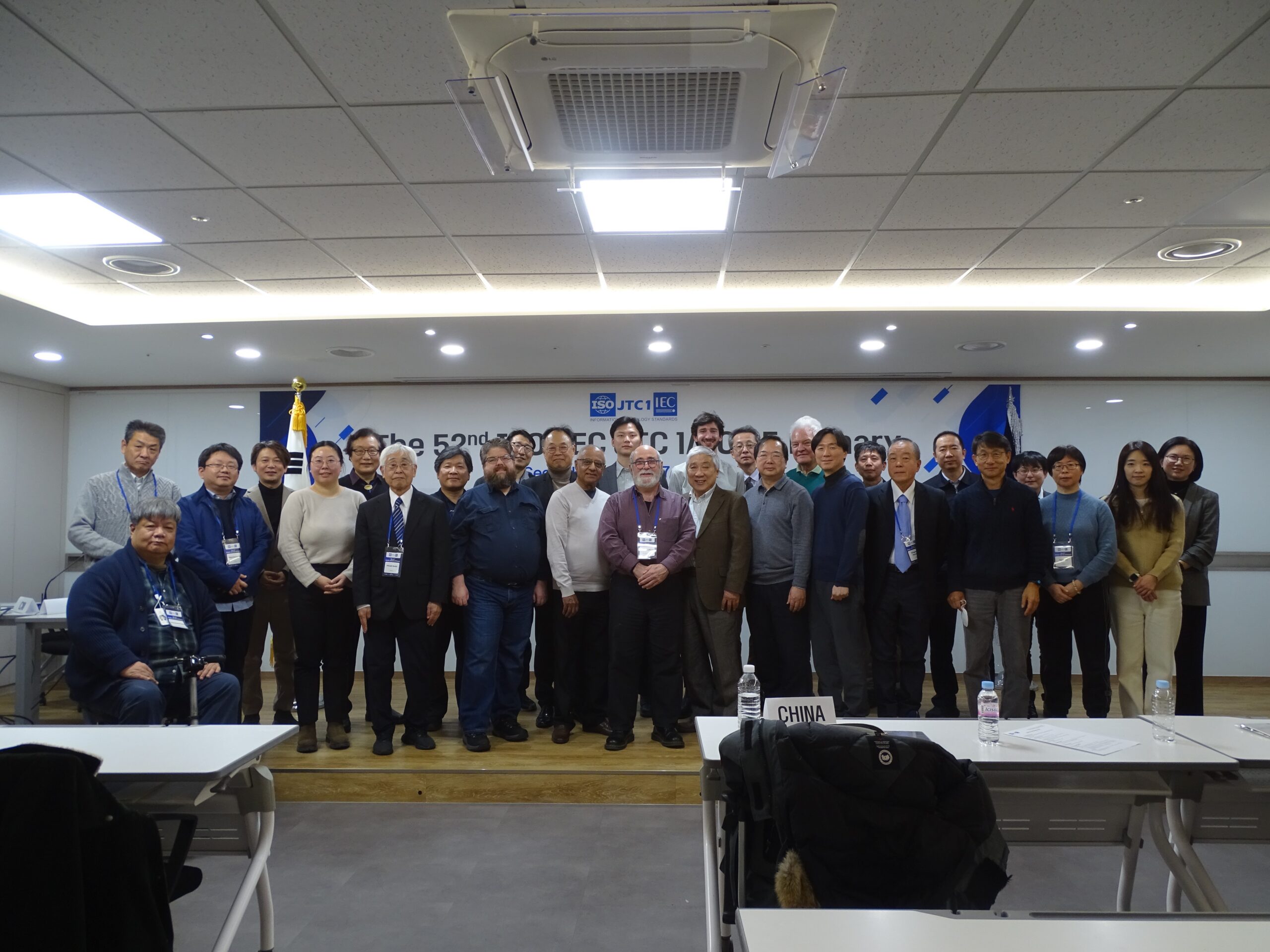
SC 35 experts during their January 2025 meeting