ISO/IEC JTC 1/SC 43
Brain-computer Interfaces
March 2026
Introduction
Reconstituted from the Advisory Group 16 (AG16) of JTC 1, ISO/IEC JTC 1/SC 43 was established as an international standards committee in March 2022 and responsible for standardization in the area of brain-computer interfaces (BCI).
Scope
Standardization in the area of Brain-computer Interfaces for information technology to enable communication and interaction between brain and computers that are applicable across application areas.
- Serve as the focus and proponent for JTC 1’s standardization program on brain-computer interfaces, including the development of foundational standards;
- Provide guidance on brain-computer interfaces to JTC 1, IEC, ISO and other entities developing applications of BCI.
Excluded: standards for human implants and medical applications.
Public Website
ISO: https://www.iso.org/committee/9082407.html
IEC:https://www.iec.ch/dyn/www/f?p=103:7:604497340624950::::FSP_ORG_ID,FSP_LANG_ID:28794,25
Membership
Participating Members (11):
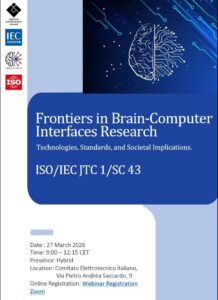
Australia (AU), China (CN), Germany (DE), India (IN), Italy (IT), Japan (JP), Korea, Republic of (KR), Russian Federation (RU), Sweden (SE), United Kingdom (GB), United States of America (US)
Observing Members (12):
Argentina (AR), Austria (AT), Belgium (BE), Brazil (BR), Finland (FI), France (FR), Hungary (HU), Netherlands (NL), Poland (PL), Singapore (SG), Slovakia (SK), Spain (ES)
Standards and projects under SC 43
Ongoing:
ISO/IEC 27572 ED1: Information Technology — Brain-Computer Interfaces — Reference Architecture
ISO/IEC TR 27573 ED1: Information technology – Brain-Computer Interfaces – Overview of ethical and societal concerns
ISO/IEC TS 27574 ED1: Information technology – Brain-Computer Interfaces – Testing and post market surveillance protocols for non-medical BCIs
ISO/IEC 27575 ED1: Information Technology – Brain-Computer Interfaces – Multi-modal neural data format for BCI
ISO/IEC TR 27576 ED1: Information technology – Brain-Computer Interfaces – Usability evaluation of BCI applications
ISO/IEC TR 27577 ED1: Information technology – Brain-Computer Interface communication protocols – Part 1: Overview
ISO/IEC 27578 ED1: Information technology – Brain-Computer Interfaces – Guidance for addressing security threats in BCI Systems
ISO/IEC TR 27599 ED2: Information technology – Brain-Computer Interfaces – Use cases
PWI JTC1-SC43-5 Information technology – Brain-Computer Interfaces – Design considerations for BCI developers
PWI JTC1-SC43-6 Information technology – Brain-Computer Interfaces – Guidance on context-based adaptive interfacing for multi-purpose BCl systems
PWI JTC1-SC43-8 Information technology – Brain-Computer Interfaces – Coding and decoding methods for non-invasive BCI
PWI JTC1-SC43-10 Information technology – Brain-Computer Interface communication protocols – Part 2: Communication between electrodes and sensor & effector interfaces
PWI JTC1-SC43-11 Information technology – Brain-Computer Interface communication protocols – Part 3: Communication between sensor & effector interfaces and control interfaces
PWI JTC1-SC43-12 Information technology – Brain-Computer Interface communication protocols – Part 4: Communication between control interfaces and external devices
PWI TR JTC1-SC43-13 Information technology – Brain-Computer Interfaces – Application of non-invasive BCI in education
PWI JTC1-SC43-14 Information technology – Brain-Computer Interfaces – Auxiliary functional components for calibration and reliability assessment using neuro-muscular evoked responses
PNW JTC1-SC43-208 ED1: Information technology – Brain-Computer Interfaces – Framework for fusion and quality profiling of Non-Invasive BCI data
PNW TS JTC1-SC43-217 ED1: Information technology – Brain-Computer Interfaces – Application of non-invasive BCI for Disorders of Consciousness
Published:
ISO/IEC 8663:2025 ED1: Information Technology – Brain-Computer Interfaces – Vocabulary
ISO/IEC TR 27599:2025 ED1: Information Technology – Brain-Computer Interfaces – Use Cases
ISO/IEC TS 27571:2026 ED1: Information Technology – Brain-Computer Interfaces – BCI data format for Non-Invasive brain information collection
Structure
|
WG/AG |
Title |
Activity |
Convenor |
|
ISO/IEC JTC 1/SC 43/WG 1 |
Foundational standards |
|
Mr Saurin S Parikh |
|
ISO/IEC JTC 1/SC 43/WG 2 |
Applications |
|
Mr Arpan Banerjee |
|
ISO/IEC JTC 1/SC 43/AG 3 |
Chair’s Advisory Group (CAG) |
|
Ms Yuntao Yu |
|
ISO/IEC JTC 1/SC 43/AG 4 |
Liaisons and Communications Advisory Group (LCG) |
|
Mr Xin Zhang |
|
ISO/IEC JTC 1/SC 43/WG 5 |
BCI Data |
1)Development of a BCI Data framework 2)Development of BCI Data processing regarding collection, representation, visualization, transmission and storage in BCI Data framework. 3)Development in the following areas: – BCI Metadata – Brain information acquisition and data fusion specification – Standardization of neural data representation – Characterization, standardization of multiple-modal information |
Ms Young-Im Cho |
|
ISO/IEC JTC 1/SC 43/WG 9 |
Ethics and Trustworthiness |
Development in the following brain-computer interfaces areas: security, safety, privacy, and ethics. |
Mr Jiangbo Pu |
|
ISO/IEC JTC 1/SC 43/WG 11 |
Responsible use of BCI |
To develop guidance, standards, and frameworks to ensure the responsible deployment and use of brain-computer interfaces technologies. |
Mr Dave Vernon Board Ms Tamar Makin |
|
ISO/IEC JTC 1/SC 43/AhG 10 |
Scope Improvement |
To redefine the scope of JTC 1/SC 43 in alignment with the purpose of the committee and its existing boundaries |
Mr David Vernon Board Mr Jacek Eisler |
Liaison
|
Committee |
Description |
Incoming liaison representative |
Outgoing liaison representative |
|
Liaison |
|||
|
IEC/TC 62 |
Medical equipment, software, and systems |
Ms Tae Hwa Han |
Mr Jian Xu Mr Kim Yan |
|
IEC TC 65/SC 65A |
System aspects |
Mr Nirav Chokshi |
Mr David Board |
|
IEC/TC 100 |
Audio, video and multimedia systems and equipment |
Mr Hirokazu Tanaka |
Mr Yun Jae Won |
|
IEC/TC 124 |
Wearable electronic devices and technologies |
Mr Jong Hong Jeon |
Mr Jiangbo Pu |
|
IEC/SyC AAL |
Active Assisted Living |
Ms Tae Hwa Han |
Ms Tae Hwa Han Mr Prabhat Ranjan |
|
ISO/TC 150 |
Implants for surgery |
|
Ms Ting Li |
|
ISO/TC 215 |
Health informatics |
Ms Seong-Min Kim |
Mr Azizuddin Khan |
|
ISO/IEC JTC 1 |
Information technology (WG13, WG 15, AG 15) |
|
Mr Jiangbo Pu Ms Brandy Smith Mr Kim Yan |
|
ISO/IEC JTC 1/SC 6 |
Telecommunications and information exchange between systems |
Mr Hyun Kook Kahng Mr Yun Jae Won |
Mr Wei Ma Mr Yun Jae Won |
|
ISO/IEC JTC 1/SC 27 |
Information security, cybersecurity and privacy protection |
Mr Srinivas Poosarla |
Ms Jyoti Kushwaha Mr Kim Yan |
|
ISO/IEC JTC 1/SC 35 |
User interfaces |
Mr Yoshikazu SEKI |
Ms Xingwei An Mr Yoshikazu SEKI
|
|
ISO/IEC JTC 1/SC 36 |
Information technology for learning, education and training |
|
Ms Surabhi Sonam Mr Kim Yan |
|
ISO/IEC JTC 1/SC 41 |
Internet of Things and Digital Twin |
Mrs Amélie GYRARD Mr Antonio KUNG |
Mr Kim Yan |
|
ISO/IEC JTC 1/SC 42 |
Artificial Intelligence |
|
Ms Youngim Cho Mr Jiangbo Pu |
|
ISO/IEC JTC 1/SC 44 |
Consumer protection in the field of privacy by design |
Mr Kim Yan |
|
|
Liaison A |
|||
|
ANEC |
European Association for the co-ordination of consumer representation in standardization |
Mr Malcolm Fisk, Mrs Michela Vuerich |
|
|
Liaison C |
|||
|
iBCI-CC |
Implantable Brain-Computer Interface Collaborative Community |
|
|
R-Member
|
Committee |
Description |
R-member representative |
|
IEC/ISO JSyC BDC |
IEC/ISO Joint Systems Committee on Bio-digital Convergence |
Mr Kim Yan |
Meeting history
|
No. |
Type |
Date |
Location |
Total Attendance |
|
1 |
Workshop |
2022.09.26 |
Zoom(virtual) |
50 |
|
2 |
The 1st Plenary |
2022.09.27-29 |
Zoom(virtual) |
57 |
|
3 |
The 2nd Plenary |
2023.03.27-31 |
Zoom(virtual) |
49 |
|
4 |
The 3rd Plenary |
2023.09.04-07 |
Hangzhou, China |
62 |
|
5 |
Workshop |
2023.09.06 |
Hangzhou, China |
200+ |
|
6 |
The 4th Plenary |
2024.04.15-18 |
Tianjin, China |
58 |
|
7 |
Workshop & “SHE” Forum |
2024.4.17 |
Tianjin, China |
200+ |
|
8 |
The 5th Plenary |
2024.09.02-06 |
Sydney, Australia |
50 |
|
9 |
Brain-computer interface symposium: bridging innovation and application |
2024.09.04 |
Sydney, Australia |
200+ |
|
10 |
The 6th Plenary |
2025.03.03-06 |
Seongnam-si, Korea |
53 |
|
11 |
International Symposium on BCl research and Standards |
2025.03.06 |
Seongnam-si, Korea |
100+ |
|
12 |
The 7th Plenary |
2025.09.08-12 |
New Delhi, India |
65 |
|
13 |
ISO/IEC JTC 1/SC 43 & SyC BDC-symposium |
2025.09.12 |
New Delhi, India |
100+ |
|
14 |
The 8th Plenary |
2026.03.23-27 |
Milano, Italy |
65 |
|
15 |
International Symposium – Frontiers in brain-computer interface research: Technologies, standards, and societal implications |
2026.03.26 |
Milano, Italy |
100+ |
1. Workshop (2022.09.26)
This workshop held virtually on September 26, and have 50 participants.
Highlights in the workshop:
- JTC 1/SC 43 introduction on its history and basic information
- Presentation from ISO/TC 150, ISO/TC 215, IEC/TC 62, IEC/TC 124, IEC/SyC AAL and IEC/TC 100, including information about TCs and their potential work item related to JTC 1/SC 43
- Common interests or working areas showed between invited TC and JTC 1/SC 43, indicating a positive step to promote constructive cooperation in the future
2. The 1st Plenary (2022.09.27-29)
The 1st plenary meeting was held virtually on September 27 – 29, 2022. A total of 57 participated the meeting.

Highlights in the 1st Plenary:
- New organizational structure
- Establishment of 2 WGs ang 2 AGs
- Liaison relationship with ISO/TC 215, ISO /TC 150, IEC/TC 124, IEC/TC 124, IEC/TC 62, IEC/TC 100, IEC/SyC AAL, IEC/SyC COMM
- Two SC43 plenary meetings each year
- An adH meeting during two plenary days, giving delegates an opportunity to informally discuss topics and items of interest for SC43
3. The 2nd plenary meeting (2023.03.27-31)
The 2nd plenary was virtually held on March 27-31, 2023. It had 49 participants.

Highlights in the 2nd Plenary:
- Timeframe extension for ISO/IEC 8663 ED1 on BCI vocabulary
- A PWI in WG 1 on BCI Reference architecture
- Draft JTC 1/SC 43 SBP
- Allocation of LCG (AG4) convenor
- Nomination of liaison representatives from JTC 1/SC 43 to ISO/TC 150, IEC/TC 62, IEC/TC 100
- A proposed TS on BCI data format for Non-Invasive brain information collection
4. The 3rd plenary meeting (2023.09.04-07)
The 3rd plenary was held in Hangzhou, China on September 04-07, 2023. A total of 62 participants joined the meeting both offline and online.
Highlights in the 3rd Plenary:
- Approval of the circulation of the current working document ISO/IEC 8663 as a CD
- Appointment of Project Editor of PNW TS JTC1-SC 43-53 Non-Invasive BCI Data Format
- Revision of the ToR of Working Group 1 Foundational standards
- Establishment of SC 43 Working Group 5 on BCI Data
- Establishment of the liaison relationship with JTC 1/SC 41 and JTC 1/SC 42
5. Workshop (2023.09.06)
This workshop aimed to promote international communication on BCI technology and industry development. 7 BCI experts from 4 countries were invited to give keynote speeches. More than 200 audiences participated the workshop.

6. The 4th plenary meeting (2024.04.15-18)
The 4th plenary was convened in Tianjin, China on April 14-15, 2024. It saw participation from a total of 58 experts, both in person and virtually.

Highlights in the 4th Plenary:
- Approval to initiate the DIS ballot for ISO/IEC 8663, and DTR ballot for ISO/IEC TR 27599.
- Approval of 3 new PWIs
- Establishment of liaison relationships with JTC 1/SC 27, JTC 1/SC 35, JTC 1/SC 36 and IEC/ISO SyC Bio-digital convergence (BDC)
7. Workshop & “SHE” Forum
At this workshop, a total of 14 experts were invited to deliver keynote speeches on the development, application, and standardization progress of BCI technology. Additionally, the “SHE” forum invited female experts to give speeches and participate in round table discussions with the aim of promoting gender diversity, acknowledging the contributions of female experts, and encouraging female participation. The workshop and forum were attended by more than 200 audience members.

8. The 5th Plenary meeting (2024.09.02-06)
The 5th plenary was convened in Sydney, Australia on September 2-6, 2024 with a total of 50 attendees.

Highlights in the 5th Plenary:
- A new PWI on BCI hardware interfaces and protocols
- Establishment of AhG 6 Ethics and Trustworthiness and AhG 7 Application of Non-Invasive BCI for Disorders of Consciousness
- Registered Member (R-Member) to the IEC/ISO JSyC BDC
9. Brain-computer interface symposium: bridging innovation and application (2024.09.04)
To promote international communication on BCI technology and industry development, the workshop was organized, featuring keynote speeches from 14 professional experts. This symposium was organized in collaboration with IEC Academy.

10. The 6th Plenary meeting (2025.03.03-06)
The 6th plenary was held in Seongnam-si, Korea on March 3-6, 2025 with a total of 53 attendees.

Highlights in the 6th Plenary:
- 2 new projects and 4 new PWIs
- Establishment of JTC 1/SC 43 WG9: Ethics and Trustworthiness
11. International Symposium on BCl research and Standards (2025.03.06)
In support of international collaboration in BCI research and commercialization, a half-day symposium on 6 March (09:00-13:00 KST) was conducted. The event included 7 expert keynote presentations addressing cutting-edge developments, along with 2 panel discussions examining critical industry challenges and opportunities.

12. The 7th Plenary meeting (2025.09.08-12)
The 7th plenary was held in New Delhi, India on September 8-12, 2025 with a total of 65 attendees.
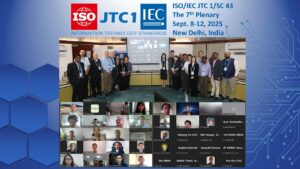
Highlights in the 7th Plenary:
- 6 new projects and 1 new PWI
- Establishment of JTC 1/SC 43 WG11: Responsible use of BCI
- Establishment of JTC 1/SC 43 AhG 10: JTC 1/SC 43 Scope Improvement
- Establishment of liaison relationships with JTC 1/WG 15, JTC 1/AG 15, IEC TC 65/SC 65A and IEC/ISO SyC Bio-digital convergence (BDC)
- Request to JTC 1 for free availability of ISO/IEC 8663 and ISO/IEC 27572 upon publication
13. ISO/IEC JTC 1/SC 43 & SyC BDC-symposium (2025.09.12)
To advance international collaboration and standardization in brain-computer interfaces and human augmentation technologies, a joint hybrid symposium of ISO/IEC JTC 1/SC 43 and IEC/ISO JSyC BDC was conducted on 12 September 2025 (09:00 to 13:00 IST). The event featured 7 expert keynote presentations covering foundational concepts, clinical and metaverse applications, regulatory frameworks, and AI-assisted sensors, followed by a discussion panel examining future strategic and standardization directions.

14. The 8th Plenary meeting (2026.03.23-27)
The 8th plenary was held in Milan, Italy on March 23-27, 2026 with a total of 65 attendees.
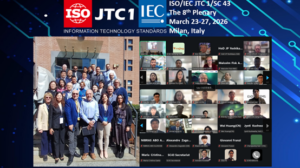
Highlights in the 8th Plenary:
- 3 new projects and 5 new PWIs
- Establishment of liaison relationships with JTC 1/WG 13 Trustworthiness
- Receipt of liaison application from ANEC (European Consumer Voice in Standardization)
15. International Symposium – Frontiers in brain-computer interface research: Technologies, standards, and societal implications (2026.03.27)
A hybrid symposium titled “Frontiers in Brain-Computer Interface Research” was conducted on 27 March 2026 in Milan, organized by ISO/IEC JTC 1/SC 43 in collaboration with CEI and the IEC Academy. The event gathered over 100 global experts across more than 20 countries, featuring 9 keynote presentations addressing non-invasive and wearable systems, clinical applications, and legal and ethical considerations, alongside dynamic discussions on international standardization priorities.